

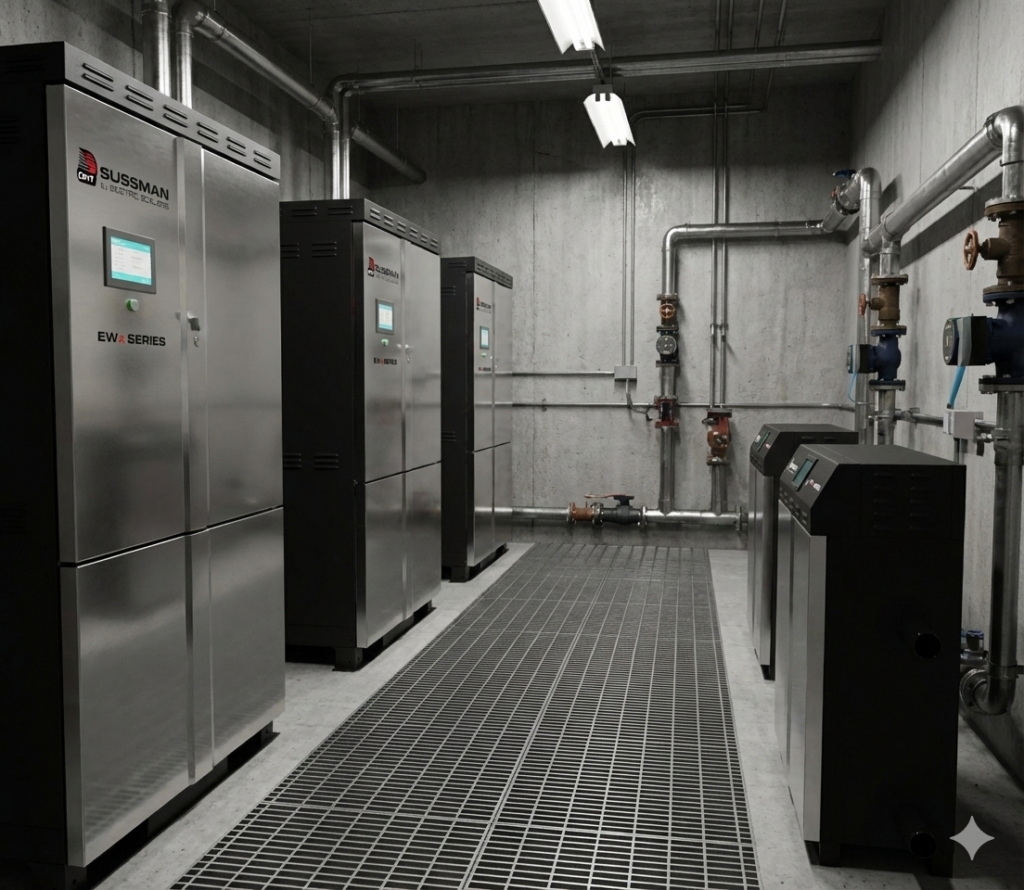
Sustainability targets in commercial and industrial facilities are becoming more defined and more enforceable. Owners and operators are under pressure to reduce onsite emissions, improve energy performance, and document progress toward corporate ESG and municipal decarbonization goals. Heating systems are central to that effort, particularly in buildings and plants where hydronic heat supports comfort, process loads, or both.
Electric boilers are no longer viewed as a future concept. In many applications, they are a viable, spec-ready solution today. Sussman Electric Boilers provide high-efficiency hot water heating without onsite combustion, making them well suited for facilities pursuing electrification, emissions reduction, and improved indoor environmental quality¹.
Heating systems and sustainability targets
Space heating and process heating often represent one of the largest energy loads in commercial and industrial facilities. Conventional gas-fired boilers create direct onsite emissions and require combustion air, venting, and fuel infrastructure. Even high-efficiency condensing boilers continue to generate Scope 1 emissions by definition².
Electric boilers address this challenge directly by eliminating onsite combustion. From a sustainability and compliance perspective, that aligns with three increasingly common requirements:
- Reducing Scope 1 greenhouse gas emissions
- Supporting building electrification mandates and incentive programs
- Preparing facilities for a lower-carbon electrical grid over the equipment lifecycle³
Zero onsite combustion and emissions reduction
Because electric boilers do not burn fuel, they generate no flue gas, no NOx, and no carbon dioxide at the point of use². This is especially relevant in jurisdictions where new fossil-fuel infrastructure is restricted or discouraged, and in facilities required to report or disclose emissions data.
For ESG reporting and municipal benchmarking, replacing combustion equipment with electric heating can provide an immediate and measurable reduction in reported Scope 1 emissions, even before accounting for cleaner electricity sources.
High efficiency and predictable performance
Electric resistance boilers convert electrical energy to heat at very high efficiency, typically near 100 percent at the point of use. There are no standby flue losses, no combustion inefficiencies, and no excess air penalties.
From a system design standpoint, this offers advantages in:
- Part-load operation and seasonal variability
- Tight temperature control for process or comfort heating
- Reduced cycling when staged or modular configurations are applied⁴
For engineers, this predictability simplifies load calculations and sequencing strategies, particularly in hydronic systems with variable demand.
Supporting grid decarbonization and renewable energy
One of the key advantages of electric heating is its ability to become cleaner over time without replacing equipment. As utilities increase renewable generation, the carbon intensity of electric heat decreases automatically³.
Electric boilers also integrate well with:
- Onsite solar or renewable generation
- Green power purchasing programs
- Campus microgrids and energy management systems
- Demand response and load-shifting strategies⁵
This flexibility allows facilities to align near-term electrification projects with long-term sustainability planning.
Control, staging, and right-sizing
Oversized heating equipment wastes energy and shortens equipment life. Electric boilers can be staged in discrete increments, allowing capacity to closely follow building or process load.
Proper staging supports:
- Improved water temperature or steam pressure control
- Reduced wear from short cycling
- Redundancy without running excess capacity
From both an energy and lifecycle perspective, right-sizing is a core sustainability principle and a practical design advantage⁴.
Retrofit flexibility for existing facilities
Many sustainability initiatives focus on retrofits rather than full system replacements. Electric hot water boilers can be applied in multiple ways:
- As a direct replacement for fossil-fuel boilers in hydronic systems
- As supplemental or peak-shaving capacity
- In hybrid plants that gradually reduce fossil-fuel runtime
This phased approach is commonly used in hospitals, higher education, municipal buildings, and light industrial facilities where continuity of operation is critical.
Indoor environmental quality and mechanical room benefits
Eliminating combustion equipment removes the need for flues, combustion air openings, and burner systems. This can improve mechanical room safety, simplify layouts, and reduce noise.
These characteristics support indoor environmental quality goals that align with building wellness standards and occupant comfort requirements⁶.
Maintenance, reliability, and lifecycle impact
Electric boilers typically have fewer moving parts than combustion systems and avoid maintenance associated with burners, fuel trains, and venting. Over the equipment lifecycle, this can reduce:
- Maintenance labor and replacement components
- Downtime tied to combustion system failures
- Total environmental impact associated with service and parts replacement
For industrial and mission-critical facilities, reliability is a sustainability factor in its own right.
Alignment with LEED, WELL, and Municipal Decarbonization Programs
Electric boiler systems can support multiple sustainability frameworks, depending on project goals and documentation requirements:
- LEED (v4.1 and newer)
Supports credits related to energy optimization, emissions reduction, and building electrification strategies tied to improved operational carbon performance⁷. - WELL Building Standard
Eliminating combustion sources supports indoor air quality objectives by reducing exposure to combustion byproducts and improving mechanical system cleanliness⁶. - Municipal and State Decarbonization Plans
Many city and state programs explicitly identify building electrification and elimination of onsite fossil fuel combustion as core compliance strategies³.
Industry References
- 1. ASHRAE, ASHRAE Handbook – HVAC Systems and Equipment
- 2. National Renewable Energy Laboratory, Grid-Interactive Efficient Buildings (GEBs)
- 3. International Energy Agency, Net Zero by 2050 Roadmap
- 4. U.S. Environmental Protection Agency, Scope 1, 2, and 3 Emissions Guidance
- 5. U.S. Department of Energy, Electrification Futures Study
- 6. Rocky Mountain Institute, Building Electrification Research
- 7. U.S. Green Building Council, LEED v4.1 Energy and Atmosphere