


Decarbonization in commercial and industrial buildings is no longer a long-term aspiration. It is an active design requirement driven by state energy codes, municipal building performance standards, and corporate ESG targets. Domestic hot water (DHW) systems are often overlooked in these conversations, yet they represent a meaningful share of building energy use—particularly in healthcare, multifamily, hospitality, food processing, and institutional facilities.
Indirect water heating offers a practical path to reduce carbon emissions without compromising performance, capacity, or reliability. When paired with electrification, heat recovery, district energy, or high-efficiency central plants, indirect systems become a strategic component of low-carbon building design.
For engineers and facility owners evaluating system upgrades, here is why indirect water heating deserves serious consideration.
Understanding the Decarbonization Context
According to the International Energy Agency, buildings account for nearly 30% of global final energy consumption and 26% of energy-related CO₂ emissions¹. In the U.S., the U.S. Department of Energy identifies water heating as the second largest energy end use in many commercial facilities².
As cities adopt electrification mandates and building performance standards, combustion-based domestic hot water systems are increasingly under scrutiny. The American Society of Heating, Refrigerating and Air-Conditioning Engineers (ASHRAE) and other industry bodies emphasize:
- System efficiency optimization
- Heat recovery integration
- Electrification readiness
- Reduced standby and distribution losses
Indirect water heating aligns directly with these priorities.
What Makes Indirect Water Heating Different?
Indirect systems transfer heat from a primary source—such as an electric boiler, heat pump, gas boiler, district energy loop, or recovered process heat—to potable water through a heat exchanger. Combustion does not occur at the point of use.
This approach provides several decarbonization advantages:
- Fuel flexibility – Easily pairs with electric or renewable heat sources
- Higher thermal efficiency – Optimized heat exchanger performance
- Lower standby losses – Especially in semi-instantaneous and instantaneous designs
- Scalability – Supports staged or modular plant strategies
Diversified Heat Transfer (DHT) specializes in engineered indirect systems designed for high-demand commercial and industrial applications.
DHT Indirect Solutions and Their Role in Decarbonization
ST Series Semi-Instantaneous Water Heaters
The ST Series Semi-Instantaneous Water Heaters combine storage and high-performance heat exchangers to deliver rapid recovery while minimizing standby losses.
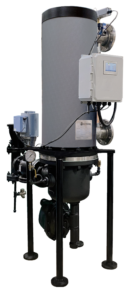
Decarbonization impact:
- Reduces oversizing compared to traditional storage tanks
- Optimizes heat transfer surface for lower approach temperatures
- Integrates seamlessly with electric boilers and heat pumps
- Supports demand-based temperature control strategies
- Minimizes maintenance requirements and costs through lesser scaling buildup due to modulated heat input
Semi-instantaneous systems are particularly effective in healthcare and multifamily applications where load diversity allows right-sizing of primary plant capacity.
LEED Callout
Supports U.S. Green Building Council LEED v4.1 Energy & Atmosphere (EA) – Optimize Energy Performance, by improving modeled building energy efficiency through reduced DHW energy consumption.
Also contributes to EA – Electrification and Reduced Fossil Fuel Use strategies in jurisdictions adopting zero-carbon codes.
WELL Callout
Supports International WELL Building Institute WELL v2 – W04 Water Quality and W07 Thermal Comfort, by enabling stable temperature control and supporting hygienic hot water distribution with controlled storage temperatures.
SP Series Instantaneous Water Heaters
The SP Series Instantaneous Water Heaters eliminate stored potable water and heat only on demand.
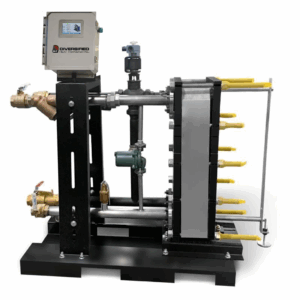
Why this matters for carbon reduction:
- Virtually eliminates standby losses
- Reduces tank heat dissipation
- Enables lower system water volumes
- Improves compatibility with electrified central plants
- Greater efficiency of central plant
- No venting or building penetrations
- Minimal parts, and maintenance requirements and costs
- Supports conversions to low temperature hydronic systems through very small approach temperature capabilities
The U.S. DOE notes that minimizing standby and distribution losses is one of the most effective ways to reduce water heating energy consumption². Instantaneous indirect systems directly address this.
LEED Callout
Supports LEED v4.1 EA – Advanced Energy Metering and Performance Optimization, by enabling tighter energy modeling and demand-based control.
Can also contribute to Innovation credits in projects pursuing aggressive electrification or net-zero energy performance.
WELL Callout
Supports WELL v2 – W08 Hygiene Support, by minimizing stagnation risks associated with large stored water volumes.
STP Series Tank and Plate Storage Water Heaters
The STP Series Tank and Plate Storage Water Heater uses a plate heat exchanger coupled with storage to deliver high-efficiency heat transfer in compact footprints.
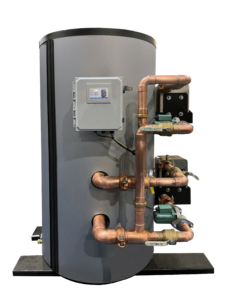
Decarbonization advantages:
- High heat transfer coefficients reduce primary water temperature requirements
- Lower return water temperatures improve heat pump and condensing plant performance
- Compact design supports retrofit electrification projects
- Ability to take any liquid waste heat and generate domestic hot water
Lower supply temperatures are especially beneficial when integrating air-to-water or water-to-water heat pumps, improving system COP and reducing lifecycle carbon.
LEED Callout
Supports LEED EA – Optimize Energy Performance, particularly in heat pump-driven systems where lower approach temperatures improve system efficiency.
May also contribute to Materials & Resources (MR) credits through durable, serviceable component design.
WELL Callout
Supports WELL – W04 Water Quality through controlled temperature management and indirect separation of potable water from primary heating fluids.
Electrification Readiness and Future Compliance
Municipal electrification policies increasingly restrict fossil fuel combustion in new construction. Indirect water heating systems simplify compliance because they:
- Centralize heat production
- Allow transition from gas to electric boilers without replacing terminal equipment
- Integrate with district thermal systems
- Support phased decarbonization strategies
This flexibility protects capital investment while enabling gradual carbon reduction.
Engineering Performance Without Compromise
One concern in decarbonization projects is maintaining temperature stability and peak demand capacity. Properly engineered indirect systems:
- Provide tight temperature control
- Deliver rapid recovery
- Support high flow rates
- Meet healthcare and institutional code requirements
DHT systems are designed for industrial-grade durability, ASME compliance, and engineered heat transfer performance—critical for mission-critical facilities.
Lifecycle Carbon and Operational Efficiency
Operational carbon reductions are only part of the equation. Indirect systems can also contribute to:
- Reduced equipment redundancy
- Lower material use versus large direct-fired tanks
- Improved system longevity
- Serviceable heat exchanger components
By optimizing heat transfer efficiency and minimizing standby losses, indirect water heating reduces both operational energy and associated Scope 2 emissions.
The Bottom Line
Decarbonization is not achieved through a single technology. It requires integrated system design, efficient heat transfer, electrification-ready infrastructure, and intelligent load management.
Indirect water heating systems—such as DHT’s ST, SP, and STP Series—provide a technically sound, future-ready approach to reducing carbon intensity while maintaining performance in demanding commercial and industrial environments. They align directly with LEED and WELL performance objectives while giving engineers the flexibility to integrate electrification, heat recovery, and high-efficiency central plants.
For projects targeting net-zero energy, municipal electrification compliance, or ESG performance benchmarks, indirect water heating is more than an alternative. It is a strategic foundation for decarbonized domestic hot water system design.
References
- 1. International Energy Agency, Buildings Sector CO₂ Emissions and Energy Data Reports
- 2. U.S. Department of Energy, Energy Saver: Water Heating & Commercial Building Energy Use
- 3. American Society of Heating, Refrigerating and Air-Conditioning Engineers, ASHRAE Position Documents on Building Decarbonization and Heat Recovery