

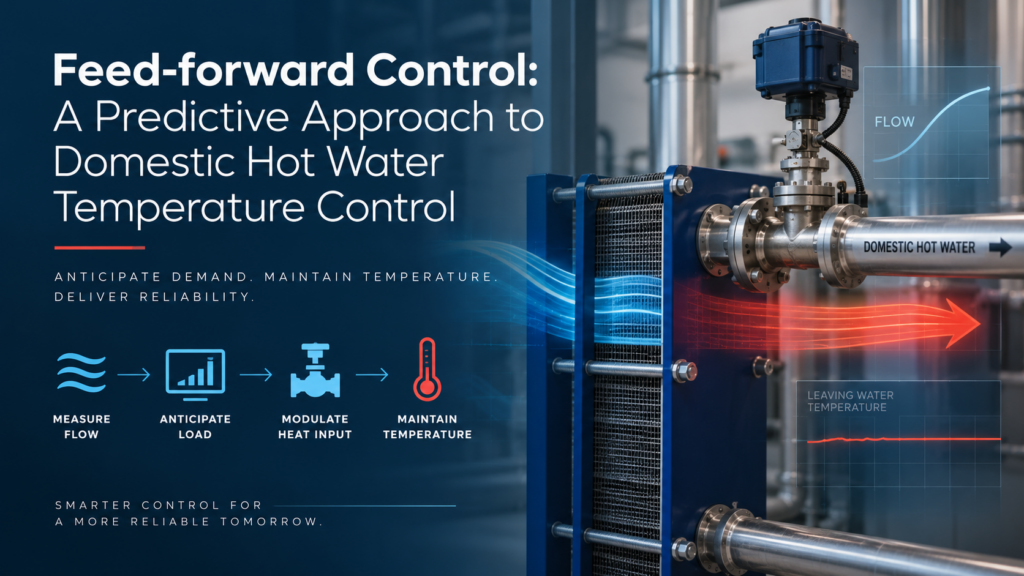
Commercial domestic hot water systems rarely operate at a constant load. A hospital can move from relatively low demand to a significant draw in minutes. Hotels experience concentrated morning and evening peaks. Residence halls, multifamily buildings, schools, and institutional facilities can see similar swings.
For the water heating system, the challenge is not simply achieving the design leaving water temperature but maintaining that temperature as flow and load conditions change.
Traditional feedback control addresses this by measuring leaving water temperature and correcting deviations from the setpoint. Feed-forward control goes a step further. It uses changes in system demand to anticipate the required heating input before a significant temperature deviation occurs.
When properly applied, feed-forward and feedback control can work together to provide faster response, tighter temperature control, improved system stability, and more efficient use of the available heating source.
The Limitation of Feedback-Only Control
A conventional feedback loop uses leaving water temperature as the primary process variable:
Load changes → Leaving water temperature changes → Sensor detects the deviation → Controller responds → Control valve modulates → Temperature returns toward setpoint
This is a proven control method, but it is inherently reactive. A measurable temperature deviation must occur before the controller responds to the change in load.
For a semi-instantaneous water heater, a sudden increase in domestic water flow requires an immediate increase in heat transfer to maintain the leaving water temperature:
Q = ṁ × Cp × ΔT
Where Q is the required heat transfer rate, ṁ is mass flow rate, Cp is specific heat, and ΔT is the required temperature rise. As flow increases, the required heat transfer rate increases proportionally when the temperature rise remains constant.
A feedback-only controller responds to the resulting temperature deviation rather than directly to the increased load. How quickly the system recovers depends on heat exchanger performance, control valve sizing and authority, sensor placement, controller tuning, heating-medium conditions, and the rate of load change.
Feed-forward Uses Load as an Input
Feed-forward control changes the sequence by introducing a measurable variable that indicates the load is changing.
In a domestic hot water application, that variable can be water flow.
Instead of waiting for leaving water temperature to fall, the controller receives the flow signal and can calculate or anticipate the corresponding change in heating requirement.
The sequence becomes:
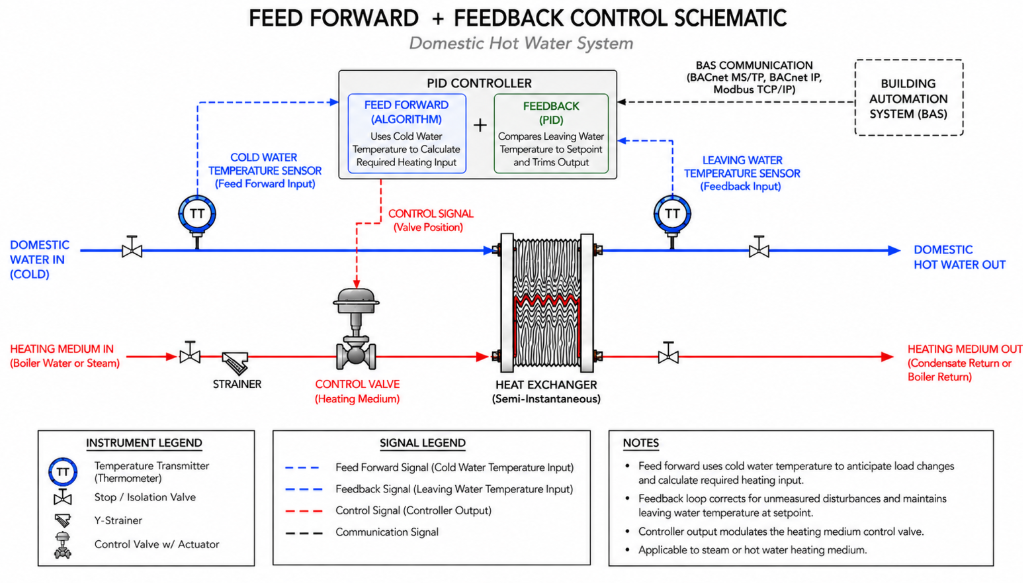
Load changes → flow is measured → controller anticipates required heat input → control valve begins repositioning → heat exchanger responds → leaving water temperature sensor verifies the result
The distinction is important.
Feedback corrects an error. Feed-forward anticipates the disturbance that would create the error.
For most practical systems, this does not mean eliminating feedback. Feed-forward and feedback serve different purposes and are most effective when used together.
Feed-forward + Feedback
A combined control strategy can use feed-forward for the initial response and feedback for final temperature correction.
The feed-forward portion responds to measurable load changes. The feedback loop continues monitoring actual leaving water temperature and trims the control output as required.
This is important because actual heat exchanger performance is affected by more than domestic water flow.
Entering water temperature can change seasonally. Steam pressure or boiler-water supply temperature can vary. Heat exchanger surfaces can foul over time. Valve characteristics are not perfectly linear. System pressure conditions can change.
Feed-forward provides anticipation.
Feedback provides verification.
Together, they allow the controller to respond to a changing load without relying exclusively on temperature error to initiate the response.
Why This Matters in Semi-Instantaneous and Instantaneous Systems
Feed-forward control can be particularly useful in systems with limited storage.
A large storage tank provides thermal mass that can absorb short-term differences between heat input and hot water demand. Semi-instantaneous and instantaneous systems have less stored energy available to buffer a rapid load change.
Control response therefore becomes increasingly important.
A properly designed system needs to coordinate several components:
- Heat exchanger capacity. The heat exchanger must have sufficient capacity at the actual design temperatures and flow rates.
- Control valve. The valve must be correctly selected and sized for the available pressure differential and heating medium.
- Flow measurement. The flow signal must accurately represent changes in domestic water demand.
- Temperature sensing. Sensors need appropriate accuracy, response time, and placement.
- Controller. The control logic must coordinate feed-forward and feedback signals without creating instability.
- Heating source. Steam or boiler water must be available at the temperature, pressure, and flow required to satisfy the changing load.
- Good controls cannot compensate for an undersized heat exchanger or inadequate heating source. Feed-forward control is most effective when it is part of a properly engineered heat transfer system.
Tighter Temperature Control During Load Changes
One of the principal objectives of feed-forward control is reducing the magnitude and duration of temperature excursions.
When domestic water flow rises rapidly, feed-forward logic can begin increasing heating input before the leaving water temperature experiences the full effect of that load increase.
When flow decreases, the opposite occurs. Heating input can be reduced earlier, helping limit temperature overshoot.
The potential result is a narrower operating band around the leaving water temperature setpoint, particularly during rapid load transitions.
This can be important in buildings where demand changes frequently and maintaining predictable hot water temperatures is an operational priority.
Temperature Control and Water Safety
Stable domestic hot water temperature is an important part of system safety. Building water systems must balance hot water availability, Legionella risk management, scald protection, and applicable plumbing codes.
ASHRAE Standard 188 and ASHRAE Guideline 12 address Legionella risk management in building water systems, while CDC guidance identifies temperature control and monitoring as key elements of an effective water management program.
Feed-forward control does not replace mixing valves, high-temperature limits, or other required safety devices. It can help maintain more consistent operating temperatures as DHW demand changes.
Better Control Can Also Reduce Energy Waste
Feed-forward control should not be viewed as an energy-saving device by itself. Energy performance depends on the entire system.
The opportunity comes from matching heating input more closely to actual load.
In a poorly controlled system, repeated overshoot and recovery can introduce more heat than necessary, followed by corrective valve movement as the controller attempts to return to setpoint.
A properly implemented feed-forward strategy can reduce unnecessary control excursions by adjusting heating input sooner.
This can provide several operational benefits:
• Reduced temperature overshoot and undershoot
• Less unnecessary heating during rapidly decreasing loads
• More stable control valve operation
• Better utilization of lower-temperature heating sources
• Improved system response across changing operating conditions
The actual energy impact will depend on load profile, heating source, control sequence, distribution system, recirculation strategy, equipment sizing, and operating temperatures.
Feed-forward Control for Modern Heating Systems
As commercial buildings move toward lower-temperature hydronic systems and electrified central plants, control response becomes increasingly important. Heat pumps, condensing boilers, electric boilers, and thermal storage can operate with lower heating-water temperatures than traditional systems.
Lower heating-water temperatures can reduce the available temperature difference across the heat exchanger, making heat exchanger sizing, flow rates, approach temperatures, and control response more critical.
Feed-forward control does not increase heat exchanger capacity. It helps the system use available capacity more effectively by anticipating load changes and adjusting heating input sooner. For lower-temperature and electrified systems, heat exchanger selection and control strategy should be evaluated together.
Example: Rapid Morning Demand
Consider a multifamily building during the morning peak, when showers and fixtures create a rapid increase in domestic hot water demand.
Feedback-only control:
DHW flow increases → Leaving water temperature drops → Sensor detects the deviation → Controller increases heating input → Temperature recovers.
Feed-forward + feedback control:
DHW flow increases → Flow sensor detects the change → Controller anticipates the additional load → Heating input increases → Temperature sensor verifies and fine-tunes the response.
The difference is timing. Feedback reacts to a temperature change. Feed-forward responds to the load change before a significant temperature deviation occurs.
Together, they provide faster response and tighter temperature control during changing DHW demand.
Applications Where Feed-forward Control Can Add Value
The greatest benefit is generally found where domestic hot water loads are large, variable, or change rapidly.
Typical applications include healthcare facilities, hospitals, universities, residence halls, hotels, multifamily buildings, correctional facilities, institutional buildings, and other central domestic hot water plants.
It can also be valuable in process water and other heat transfer applications where flow represents a measurable disturbance to the controlled temperature.
Engineering the Complete System
A sophisticated controller alone does not guarantee good temperature control.
Successful operation depends on how the complete system is designed.
The heat exchanger, valve, sensors, controller, heating source, pumps, mixing equipment, piping, and building automation system all interact.
Valve turndown must be appropriate for minimum-load operation. Sensors must be installed where they can accurately represent system conditions. Heat exchanger capacity must be evaluated at actual entering temperatures rather than nominal plant temperatures. The heating source must be capable of responding to the required load.
Control sequences should also be commissioned under more than one operating condition. A system that maintains setpoint at design load should also be evaluated during minimum load and rapid load transitions.
The objective is not simply to maintain setpoint under steady-state conditions.
The objective is to maintain stable operation when the building changes.
How DHT Can Help
Diversified Heat Transfer designs domestic hot water and heat transfer equipment as complete systems, with the heat exchanger and controls selected to work together under real operating conditions.
DHT’s ST Series Semi-Instantaneous Water Heaters combine high-capacity heat transfer with advanced temperature control for commercial domestic hot water applications. Systems can be configured for steam or boiler-water heating media and are available with advanced PID controls and building automation communication.
For applications using plate heat exchanger technology, the SP Series Instantaneous Water Heaters provides compact, responsive heat transfer for variable domestic hot water loads.
The STP Series Tank & Plate Water Heaters combines plate heat exchanger performance with storage capacity in a factory-packaged system, providing another option where load management and recovery requirements favor a tank-and-plate design.
For boiler-water applications, DHT’s SPM Series Semi-Instantaneous Water Heater integrates a double-wall plate-and-frame heat exchanger, digital mixing valve, and advanced controls into a packaged system. The design is particularly well suited for modern hydronic plants using medium-, normal-, or lower-temperature boiler water.
DHT can also assist engineers in evaluating heat exchanger sizing, heating-medium temperatures, peak flow requirements, temperature approach, controls, and equipment configuration as part of the overall domestic hot water system design.
As buildings become more dynamic and central plants move toward lower-temperature and electrified heating sources, control strategies become increasingly important.
The goal is simple: Measure the load. Anticipate the change. Deliver the required heat. Verify the temperature.
That is the difference between simply reacting to a system and actively controlling it.
Industry References
ASHRAE Standard 188 – Legionellosis: Risk Management for Building Water Systems
ASHRAE Guideline 12 – Managing the Risk of Legionellosis Associated with Building Water Systems