

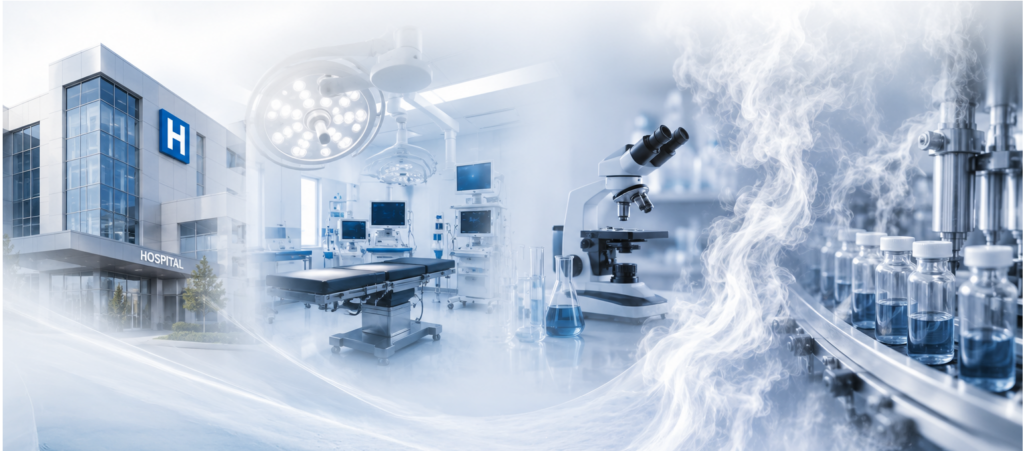
Healthcare facilities depend on steam every day for sterilization, infection prevention, humidification, and a variety of process applications. Hospitals, ambulatory surgery centers, laboratories, pharmaceutical manufacturers, and medical device companies all rely on consistent steam quality to keep critical operations running safely and efficiently.
For central sterile processing departments (CSPD), steam is more than a utility. It is essential for sterilizing reusable surgical instruments and medical devices. According to ANSI/AAMI ST79, steam sterilization remains the preferred method for processing heat- and moisture-stable medical devices because of its proven effectiveness, reliability, and ability to destroy microorganisms, including bacterial spores.¹
As healthcare facilities modernize infrastructure and pursue electrification initiatives, engineers are placing greater emphasis on the quality of the steam being delivered—not just the equipment producing it.
Why Steam Quality Matters
Successful sterilization depends on more than producing steam. Sterilizers require saturated steam delivered at the proper pressure, temperature, moisture content, and purity to consistently achieve sterilization.
Poor steam quality can lead to:
- Wet packs and wet loads
- Instrument staining
- Scale and corrosion
- Increased sterilizer maintenance
- Longer cycle times
- Reduced process efficiency
- Potential sterilization failures¹
Maintaining high-quality steam improves equipment reliability while helping protect both patients and valuable medical instruments.
Understanding Steam Quality
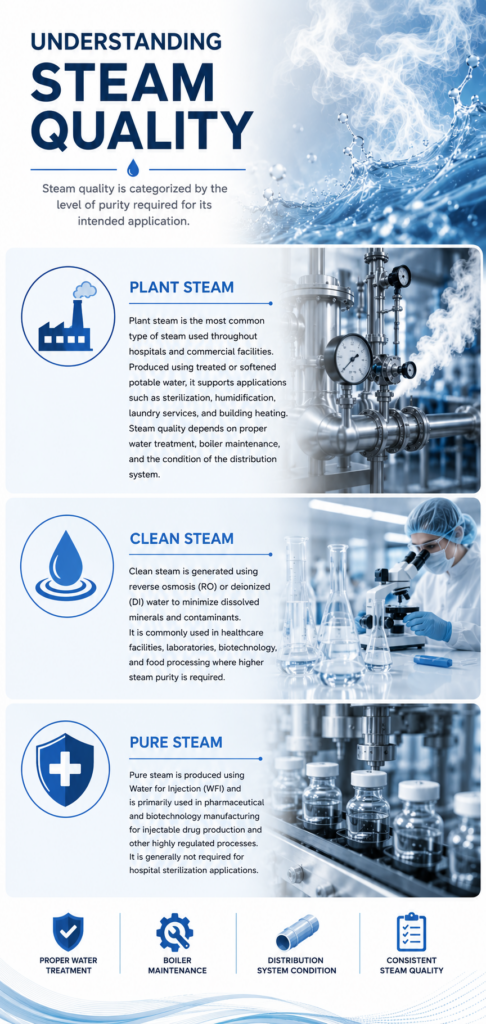
Steam quality is categorized by the level of purity required for its intended application.
Plant Steam
Plant steam is the most common type of steam used throughout hospitals and commercial facilities. Produced using treated or softened potable water, it supports applications such as sterilization, humidification, laundry services, and building heating. Steam quality depends on proper water treatment, boiler maintenance, and the condition of the distribution system.
Clean Steam
Clean steam is generated using reverse osmosis (RO) or deionized (DI) water to minimize dissolved minerals and contaminants. It is commonly used in healthcare facilities, laboratories, biotechnology, and food processing where higher steam purity is required.
Pure Steam
Pure steam is produced using Water for Injection (WFI) and is primarily used in pharmaceutical and biotechnology manufacturing for injectable drug production and other highly regulated processes. It is generally not required for hospital sterilization applications.
Why Boiler Construction Matters
The boiler itself plays an important role in maintaining steam quality.
Traditional carbon steel boilers can introduce corrosion products into the steam system over time. Even with proper water treatment, iron oxides and other contaminants may enter the distribution system, increasing maintenance requirements and affecting sterilization equipment.
Stainless steel construction helps minimize these issues.
The Sussman SSB Stainless Steel Electric Steam Boiler features 316 stainless steel construction for all wetted surfaces, providing exceptional corrosion resistance for demanding healthcare, laboratory, pharmaceutical, and clean steam applications. Every pressure vessel is passivated after fabrication to further improve corrosion resistance and long-term durability.
Benefits include:
- Reduced corrosion
- Improved steam purity
- Lower particulate contamination
- Longer equipment life
- Reduced maintenance
- Reliable long-term performance
Why Healthcare Facilities Are Choosing Electric Steam Boilers
Many hospitals continue to operate aging central boiler plants fueled by natural gas or fuel oil. While reliable, these systems require numerous support systems including burners, fuel trains, combustion controls, venting, combustion air equipment, and emissions monitoring.
Electric steam boilers simplify the system by eliminating combustion entirely.
Advantages include:
- No burners or fuel trains
- No combustion air or exhaust systems
- Reduced mechanical complexity
- Faster response to changing steam demand
- Lower maintenance requirements
- No on-site combustion emissions
- Flexible installation near the point of use
- Satisfying requirement for higher water and steam quality
These benefits make electric boilers well suited for healthcare renovations, facility expansions, and electrification projects.
Water Quality Remains Critical
Even the highest-quality boiler depends on proper feedwater.
Water treatment helps protect heating elements, maintain steam quality, and maximize equipment life. Depending on the application, facilities may use reverse osmosis, deionization, water softening, conductivity monitoring, and boiler water treatment programs. In health care settings, many are choosing to follow ANSI/AAMI ST108, which is the formal standard for water quality, medical device processing and sterilization. Complying with ST108 would require steam boilers for sterilization to be of stainless steel construction.
Important Operating Requirement
For the Sussman SSB Stainless Steel Electric Steam Boiler, deionized (DI) water with a minimum specific resistivity of 1 megohm per centimeter is required for proper and safe boiler operation in accordance with ASME Section I requirements. All ASME Section I stainless steel boilers are required to use to use DI water.
Sussman SSB Stainless Steel Electric Steam Boiler
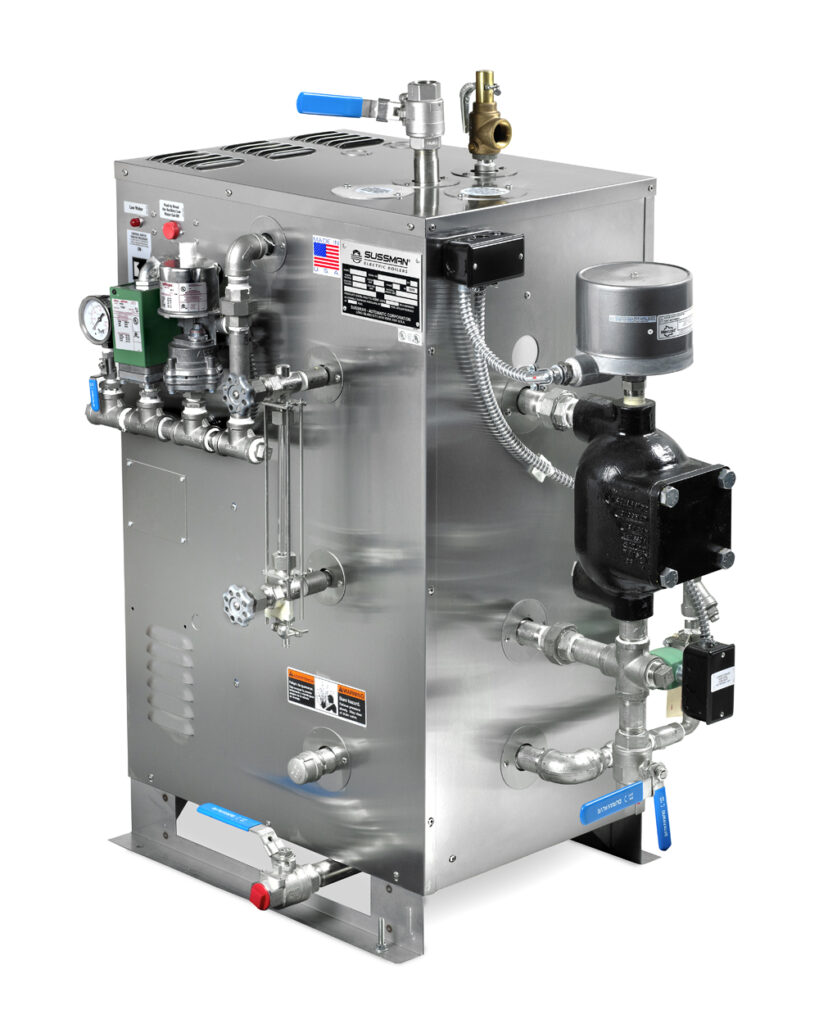
Designed specifically for applications requiring corrosion-resistant construction and dependable steam generation, the SSB Series combines electric boiler technology with Type 316 stainless steel construction to produce high-quality steam for demanding environments.
Key Features
- Type 316 stainless steel construction for all wetted surfaces
- Passivated pressure vessel
- ASME Section I construction
- National Board registered
- UL and cUL listed controls
- Factory-tested packaged design
- Compact footprint
- Rapid startup
- No combustion equipment
- Low maintenance
- Common Applications
The SSB Series is ideal for:
- Hospitals
- Central sterile processing departments (CSPD)
- Ambulatory surgery centers
- Research laboratories
- Pharmaceutical manufacturing
- Biotechnology facilities
- Medical device manufacturing
- University laboratories
Final Thoughts
As healthcare facilities invest in modernization and electrification, steam generation systems are being evaluated on more than capacity alone. Steam quality, corrosion resistance, water quality, maintenance requirements, and long-term reliability all influence system performance.
Electric stainless steel boilers provide a practical solution for facilities seeking cleaner, more reliable steam while reducing mechanical complexity. By combining Type 316 stainless steel construction, electric resistance heating, and proven engineering, the Sussman SSB Stainless Steel Electric Steam Boiler helps support the demanding sterilization requirements of today’s healthcare and life science facilities.
References
- ANSI/AAMI ST79:2017 (Amendment 2023), Comprehensive Guide to Steam Sterilization and Sterility Assurance in Health Care Facilities.
- Association for the Advancement of Medical Instrumentation (AAMI), ANSI/AAMI ST108:2023 – Water for the Processing of Medical Devices.
- ASME Boiler and Pressure Vessel Code, Section I – Rules for Construction of Power Boilers.
- U.S. Department of Energy (DOE), Electrification of Building Thermal Systems and Industrial Process Heating.
- Electric Power Research Institute (EPRI), Electric Boiler Technology Assessment for Commercial and Institutional Applications.
- ASM International, Stainless Steels Handbook.
- American Boiler Manufacturers Association (ABMA), Boiler Water Quality Requirements and Treatment Guidelines.